
Spring updates
And the position from which a story is told

Hello!
About a month ago, I published an essay with Defector about witnessing the sentencing of my first employer, Carlos Watson, the CEO of Ozy Media. Last summer, Watson was found guilty of conspiracy to commit wire fraud, conspiracy to commit securities fraud and aggravated identity theft. I worked for Ozy between 2018 and 2020 (where I met some of you). It was my first job in journalism after college and my first full-time job, full stop.
I found many beautiful people there and collaborated with wonderful colleagues, who I became especially close to as we struggled to produce good work in an extremely difficult — and at times, hostile — work environment. It was a strange introduction to the workforce, to say the least, and one I’ve tried to make sense of in the years since.
In some ways, watching Watson’s sentencing many years later compelled me to revisit this experience and refilter it (President Trump ultimately commuted Watson’s sentence of nearly 10 years the day he was due to begin it. He also no longer has to pay $96 million in forfeiture and restitution). In the courtroom, it felt strange to listen to the judge attempt to precisely quantify the financial damages of Watson’s schemes. It was not lost on me that the damages to the human beings who worked for him — whose daily lives were affected by him — cannot be quantified and will not be rectified.
I was grateful to the editors at Defector for providing space for me to reflect on this — and, more broadly, to highlight what’s often lost and left out in stories about mercurial CEOs falling from grace. I hope you’ll spend some time with the piece. Lately, I’ve been thinking a lot about the perspective from which a story is told, whether it’s in the news or creative writing, and how that shapes public understanding. As a journalist, I’m typically elevating the perspectives of other people. This time, it felt powerful to write from the place of my own.
My other update is that I recently joined The Prison Journalism Project as a volunteer editor and coach. The Prison Journalism Project is a nonprofit that trains incarcerated people to be journalists through structured curriculum, programming and mentorship. PJP also helps writers place their work, both in prison newspapers and mainstream publications. One of the organization’s goals is to ensure that incarcerated writers tell their own stories.
You can check out some of these writers’ award-winning work here. I love to help emerging writers get from 0→1 — particularly those who may be putting words to their experiences for the first time — and I’m excited to soon become one small part of this national effort.
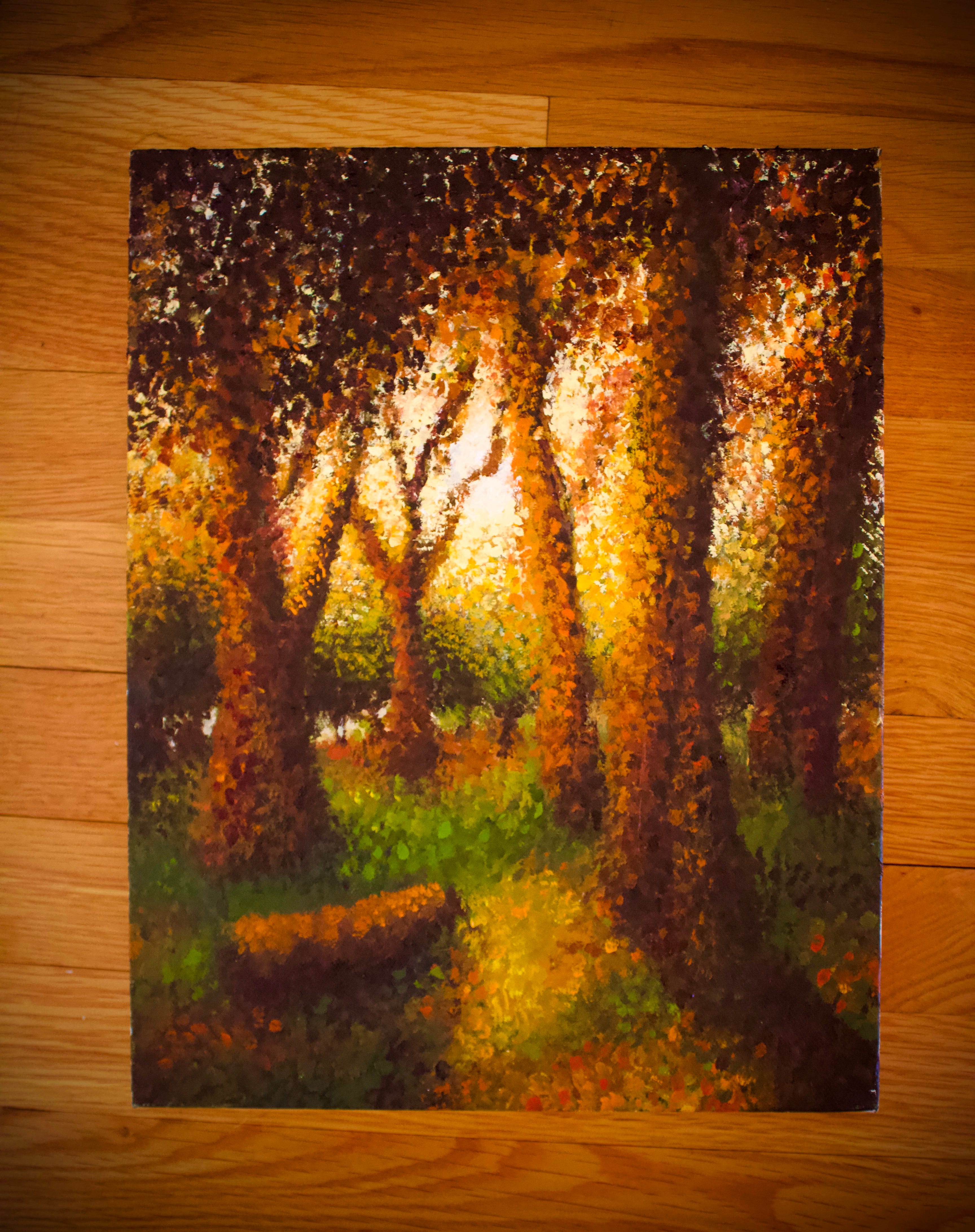
I also just wrapped up my latest painting, a love letter to Golden Gate Park at golden hour. It was inspired by a photograph shot by my talented friend Alex Samuels. This was my first time working in oil and it was such a delight to play with light and shadow in a new medium. I’m hoping to find the piece a good home, so give a shout if you know anyone who might be interested in purchasing it.
Thank you for your time, your support and for keeping up with my work!
More soon,
Carly
Carly, I didn't know you were so multi-talented. Your painting is scintillating; it will be imprinted on my vision the next time I walk through Golden Gate Park. And applause for your participation in the prison writing program. such commitments often return the gift of learning to the tutor. --Be well, Paul